Timing
When to prune shrubs: the bloom rule
One question settles most pruning dates: does the shrub flower on wood it grew last year, or on wood it grows this year?
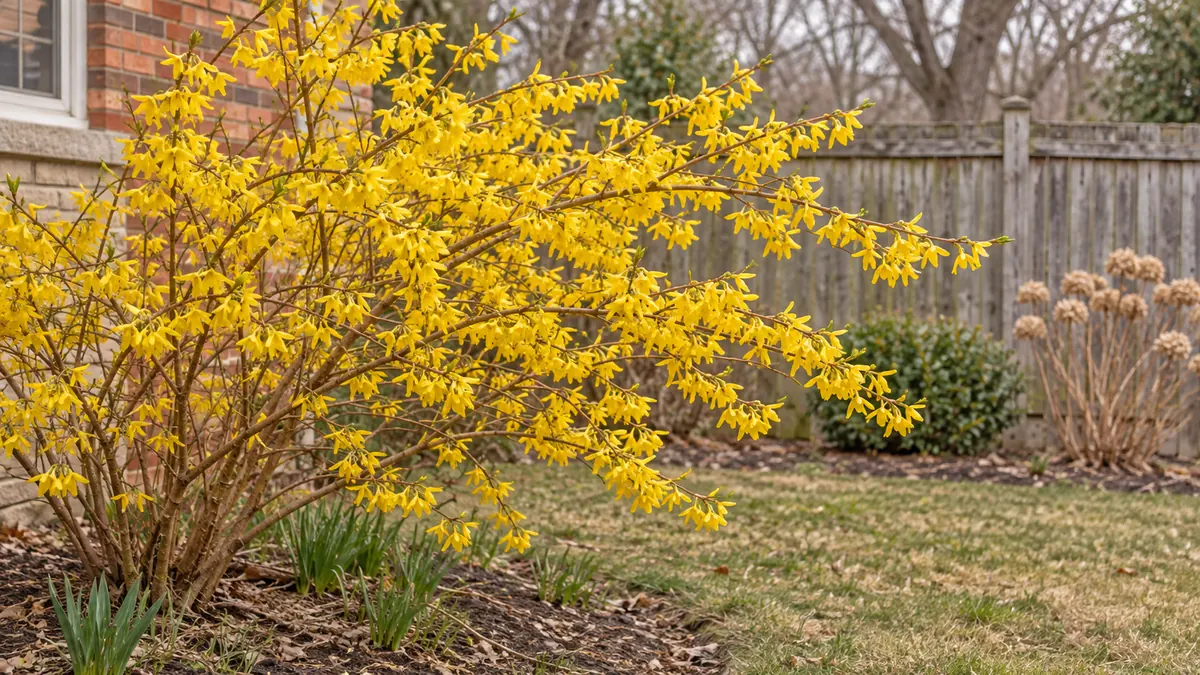
Shrubs that flower in spring carry their buds through the winter on last season's wood. Cut them in February and the buds go out with the clippings. Shrubs that flower in summer make their buds on the growth they put on in spring, so a late-winter cut costs nothing and often improves the show.
The Virginia Cooperative Extension shrub pruning calendar sorts shrubs by exactly this trait. Its first two notes are "flowers are produced on new (current season) wood" and "flowers are produced on wood from past season, pruning while dormant will reduce flowers."
Spring bloomers: prune after the flowers fade
University of Maryland Extension puts the cut-off at midsummer: if a shrub blooms before the end of June, prune it right after it flowers. On the Virginia calendar that group includes azaleas, forsythia, flowering quince, deutzia, weigela, lilac, mockorange, viburnum and spring-blooming spirea and hydrangea, with best months running from April or May into July depending on the plant.
Summer bloomers: prune while dormant
Shrubs that flower on new wood are pruned before growth starts. Clemson Cooperative Extension's guide to pruning shrubs lists this group as the one to prune before spring growth begins. On the Virginia calendar, crape myrtle, chastetree, nandina, summer-blooming hydrangea and St. Johnswort are marked for January through March. Abelia, gardenia, smoke tree and rose-of-Sharon are marked for the dormant months from November on.
The months to leave alone
The Virginia calendar marks August, September and October as "do not prune" for nearly every shrub it lists. University of Maryland Extension gives the same advice, not to prune from August to late October, and Iowa State University Extension also advises against late-summer pruning. Virginia Cooperative Extension's Pruning Shrubs gives the reason: pruning in late summer or early fall causes regrowth that may not harden off before cold weather.
Exceptions that always apply
Damage does not wait for the calendar. The Virginia publication notes that you can prune at any time to correct vandalism and hazards created by equipment or weather. It also notes that timing varies across climate zones, which in Virginia alone run from zone 8a near Virginia Beach to 5b along the West Virginia border. Treat any month on a chart as a guide and let the plant confirm it.
When you are not sure what a shrub is, University of Maryland Extension's fallback is to prune in early spring. The worst likely outcome is a season with fewer flowers.
The full table for 75 shrubs is on our pruning calendar.
Sources
- Virginia Cooperative Extension. A Guide to Successful Pruning: Shrub Pruning Calendar (Publication 430-462). https://www.pubs.ext.vt.edu/430/430-462/430-462.html
- University of Maryland Extension. Pruning Shrubs and Hedges in the Home Garden. https://extension.umd.edu/resource/pruning-shrubs-and-hedges-home-garden
- Clemson Cooperative Extension. Pruning Shrubs (HGIC 1053). https://hgic.clemson.edu/factsheet/pruning-shrubs/
- Iowa State University Extension. Proper Time to Prune Trees and Shrubs. https://yardandgarden.extension.iastate.edu/how-to/proper-time-prune-trees-and-shrubs
- Virginia Cooperative Extension. A Guide to Successful Pruning: Pruning Shrubs (Publication 430-459). https://mgnv.org/wp-content/uploads/2022/04/Pruning-430-459_pdf.pdf